

Solar battery chargers have emerged as a sustainable and efficient solution for powering various devices and vehicles. As a leading Battery Charger supplier, I am excited to share in - depth knowledge about how these innovative chargers work.
The Basics of Solar Energy Conversion
At the heart of a solar battery charger is the photovoltaic (PV) effect. PV cells, typically made of silicon, are the building blocks of solar panels. When sunlight, which consists of photons, hits these PV cells, it causes electrons in the silicon atoms to be excited. These excited electrons are then freed from their atomic bonds and can move freely within the cell.
The PV cells are designed in such a way that they have an electric field. This electric field forces the freed electrons to flow in a specific direction, creating an electric current. The amount of current generated depends on several factors, including the intensity of sunlight, the surface area of the solar panel, and the efficiency of the PV cells.
Components of a Solar Battery Charger
A typical solar battery charger consists of three main components: the solar panel, the charge controller, and the battery.
Solar Panel
As mentioned earlier, the solar panel is responsible for converting sunlight into electricity. It is made up of multiple PV cells connected in series or parallel to achieve the desired voltage and current output. For example, if a single PV cell produces 0.5 volts, connecting 10 of them in series will result in a panel output of 5 volts. The size and quality of the solar panel determine its power - generating capacity. Larger panels with higher - efficiency PV cells can produce more electricity.
Charge Controller
The charge controller is a crucial component that regulates the flow of electricity from the solar panel to the battery. Its main functions are to prevent over - charging and over - discharging of the battery. When the battery is fully charged, the charge controller reduces or stops the flow of current from the solar panel to the battery. On the other hand, if the battery voltage drops too low, it may take measures to protect the battery from damage. There are two main types of charge controllers: PWM (Pulse Width Modulation) and MPPT (Maximum Power Point Tracking).
PWM charge controllers are the more basic type. They work by rapidly switching the connection between the solar panel and the battery on and off. This helps to regulate the charging current. MPPT charge controllers, on the other hand, are more advanced. They continuously monitor the output of the solar panel and adjust the charging process to extract the maximum power available from the panel, even under varying sunlight conditions.
Battery
The battery stores the electricity generated by the solar panel for later use. Different types of batteries can be used with solar chargers, such as lead - acid batteries, lithium - ion batteries, and nickel - metal hydride batteries. Each type has its own characteristics in terms of capacity, lifespan, and charging requirements. For instance, lead - acid batteries are relatively inexpensive but have a shorter lifespan compared to lithium - ion batteries. Lithium - ion batteries are lighter, have a higher energy density, and can be charged and discharged more times.
The Charging Process
The charging process of a solar battery charger can be divided into several stages.
Bulk Charging
In the initial stage, known as bulk charging, the solar panel supplies a high current to the battery. The charge controller allows the battery to accept as much current as it can without exceeding its safe limits. During this stage, the battery voltage gradually rises. This is the fastest part of the charging process, and it can charge the battery up to about 80% of its capacity.
Absorption Charging
Once the battery reaches around 80% of its capacity, the charging process enters the absorption stage. In this stage, the charge controller reduces the charging current while maintaining a constant voltage. This helps to fully charge the battery and ensure that all the cells in the battery are evenly charged. The absorption stage can take several hours, depending on the battery size and the charging current.
Float Charging
After the battery is fully charged, the charger enters the float charging stage. In this stage, the charger provides a small amount of current to the battery to maintain its charge level. This compensates for any self - discharge that may occur over time. Float charging helps to extend the lifespan of the battery by preventing over - charging and keeping it in a fully charged state.
Applications of Solar Battery Chargers
Solar battery chargers have a wide range of applications.
Portable Devices
They are commonly used to charge portable devices such as smartphones, tablets, and power banks. Portable solar chargers are convenient for outdoor activities like camping, hiking, and traveling. They allow users to charge their devices using solar energy, even in remote areas where there is no access to a traditional power outlet.
Vehicles
Solar battery chargers can also be used to charge the batteries of vehicles such as cars, boats, and RVs. For example, a solar charger can be installed on the roof of a car to keep the battery charged and reduce the load on the vehicle's alternator. This can help to save fuel and extend the life of the battery.

Off - Grid Systems
In off - grid systems, solar battery chargers are an essential part of the power supply. They can be used to charge batteries that power homes, cabins, or other buildings in areas without access to the electrical grid. These systems often use large - capacity batteries and high - power solar panels to meet the energy needs of the users.
Our Product Offerings
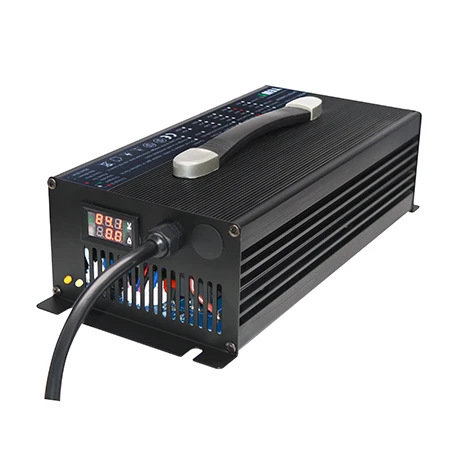
As a Battery Charger supplier, we offer a variety of high - quality solar battery chargers. Our 48v 30a Battery Charger is suitable for applications that require a high - voltage and high - current charging solution. It is designed with advanced charge control technology to ensure safe and efficient charging.
Our Fully Automatic Battery Charger is another popular product. It can automatically detect the battery type and adjust the charging process accordingly. This makes it easy for users to charge different types of batteries without having to worry about over - charging or under - charging.
For applications that need a specific voltage and current combination, our 60v 25a Battery Charger is an excellent choice. It is built with high - quality components to provide reliable and stable charging performance.
Contact Us for Procurement
If you are interested in our solar battery chargers or have any questions about how they work, we encourage you to contact us for procurement discussions. We have a team of experts who can provide you with detailed product information and help you choose the right charger for your needs. Whether you are a small - scale user or a large - scale business, we are committed to providing you with the best products and services.
References
- "Solar Power for Dummies" by Rik DeGunther
- "Photovoltaic Systems Engineering" by Thomas H. Kimbell
- Technical manuals of various solar battery charger manufacturers