

When it comes to battery chargers, one of the most common questions that consumers and businesses alike ask is, "What is the power consumption of a battery charger?" As a leading supplier of battery chargers, we understand the importance of this question and are here to provide you with a comprehensive answer.
Understanding Power Consumption Basics
Before delving into the power consumption of battery chargers, it's essential to understand the basic concepts of power. Power is measured in watts (W) and is calculated by multiplying the voltage (V) by the current (A), represented by the formula P = V × I. In the context of a battery charger, the power consumption refers to the amount of electrical energy the charger uses to charge a battery.
The power consumption of a battery charger is not constant throughout the charging process. It varies depending on several factors, including the charger's design, the battery's state of charge, and the charging method employed.
Factors Affecting Power Consumption
- Charger Design: Different charger designs have varying levels of efficiency. For example, a well - designed charger with advanced circuitry can convert a higher percentage of the input electrical energy into usable energy for charging the battery. In contrast, a poorly designed charger may waste a significant amount of energy as heat, resulting in higher power consumption.
- Battery State of Charge: When a battery is completely discharged, the charger needs to supply more power to initiate the charging process. As the battery approaches full charge, the charger reduces the charging current to avoid overcharging, which in turn reduces the power consumption.
- Charging Method: There are several charging methods, such as constant current charging, constant voltage charging, and a combination of both. Each method has a different power consumption profile. For instance, constant current charging supplies a fixed current to the battery, which means the power consumption is relatively high at the beginning of the charging process. Constant voltage charging, on the other hand, maintains a constant voltage across the battery terminals, and the power consumption decreases as the battery charges.
Power Consumption of Different Types of Battery Chargers
Let's take a look at the power consumption of some of the popular battery chargers we offer:
60v 25a Battery Charger
This charger is designed to charge high - voltage batteries efficiently. Using the power formula P = V × I, we can calculate the theoretical maximum power consumption. For a 60V 25A battery charger, the maximum power is P = 60V × 25A = 1500W. However, in real - world scenarios, the actual power consumption will be lower due to the charger's efficiency. Most modern chargers have an efficiency of around 80 - 90%. So, the actual power consumption will be in the range of 1200 - 1350W at full load.
Smart Charge Battery Charger
Smart charge battery chargers are known for their ability to adjust the charging process based on the battery's state of charge. These chargers typically have a lower power consumption compared to traditional chargers. They use sophisticated algorithms to optimize the charging process, reducing energy waste. The power consumption of a smart charge battery charger can vary widely depending on the battery it is charging, but on average, it can save up to 20 - 30% of energy compared to non - smart chargers.
12V 70A Battery Charger
For a 12V 70A battery charger, the theoretical maximum power is P = 12V × 70A = 840W. Similar to the 60V 25A charger, the actual power consumption will be reduced by the charger's efficiency. With an efficiency of 80 - 90%, the actual power consumption will be in the range of 672 - 756W at full load.
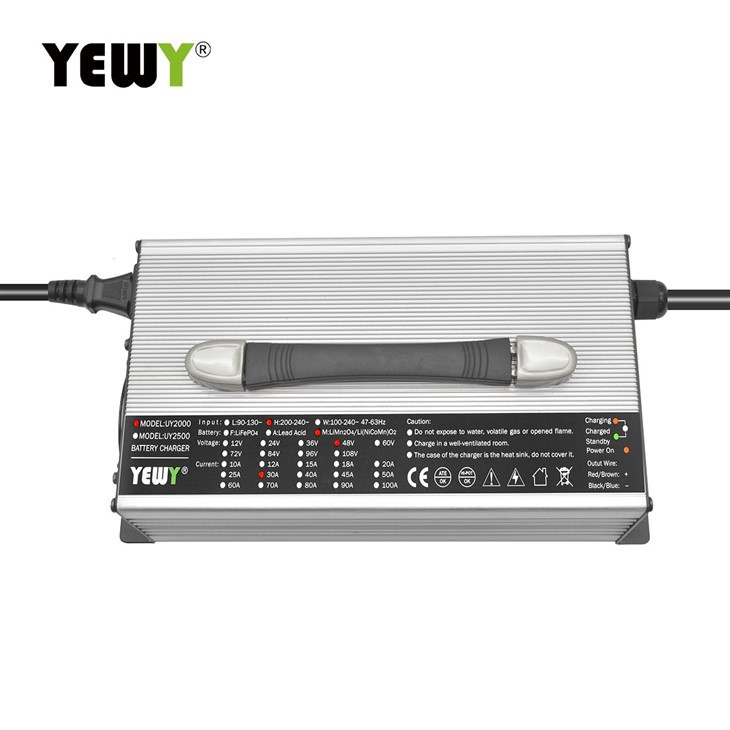

Measuring Power Consumption
To accurately measure the power consumption of a battery charger, you can use a power meter. A power meter is a device that measures the electrical power consumed by an appliance. Simply plug the battery charger into the power meter and then into the electrical outlet. The power meter will display the real - time power consumption, as well as the total energy consumed over a period of time.
Impact of Power Consumption on Costs
The power consumption of a battery charger directly affects the electricity costs. Higher power consumption means higher electricity bills. For businesses that rely on multiple battery chargers, such as forklift operators or electric vehicle charging stations, the cost savings from using energy - efficient chargers can be substantial. By choosing chargers with lower power consumption, businesses can reduce their operating costs and contribute to a more sustainable environment.
Conclusion
In conclusion, the power consumption of a battery charger depends on various factors, including charger design, battery state of charge, and charging method. As a supplier of high - quality battery chargers, we offer a range of products with different power consumption profiles to meet the diverse needs of our customers. Whether you are looking for a high - power charger for industrial applications or an energy - efficient smart charger for your personal use, we have the right solution for you.
If you are interested in learning more about our battery chargers or have any questions regarding power consumption, we encourage you to contact us for a detailed discussion. Our team of experts is ready to assist you in selecting the most suitable charger for your specific requirements and help you make an informed purchasing decision.
References
- Electricity 101: Understanding Power and Energy. Electrical Engineering Handbook, 2020.
- Battery Charging Technologies and Efficiency. Journal of Power Sources, 2019.
- Energy - Efficient Battery Chargers for Industrial Applications. International Journal of Sustainable Energy, 2021.